Guide
How to Estimate Portion Sizes Without a Kitchen Scale
Understanding how much to eat shouldn't require complex equipment or constant weighing. This guide teaches you how to use your hands and common objects to gauge serving sizes accurately for balanced nutrition.
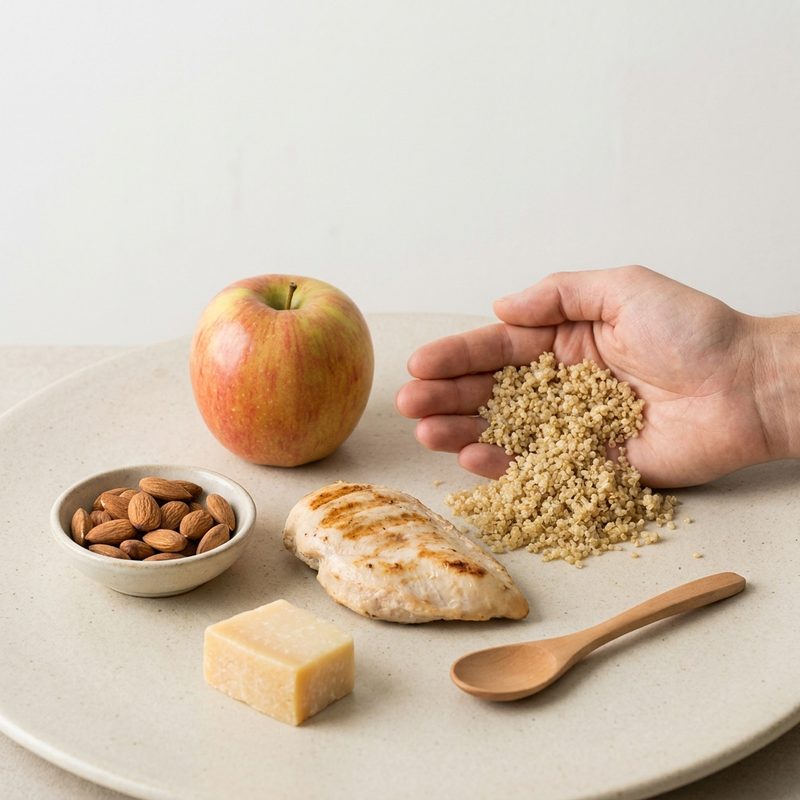
Step 1: Use Your Hand as a Portable Scale
The most convenient tool for measuring food is always with you: your hand. Since hand size is generally proportional to body size, it provides a personalized guide for macronutrient portions. For protein sources like chicken, fish, or tofu, aim for a portion the size of your palm. For dense carbohydrates like grains and starches, use a cupped hand. For vegetables, a portion should be roughly the size of your closed fist, and for fats like oils or butter, use the size of your thumb.
Step 2: Compare to Common Household Objects
If you find hand measurements difficult, visualize common items. A standard serving of meat (3 ounces) is roughly the size of a deck of playing cards. A serving of fruit or pasta is about the size of a tennis ball. For smaller measurements, a thumb tip is approximately one teaspoon, while a whole thumb is about one tablespoon. These visual cues help you maintain consistency without needing to pull out measuring spoons for every meal.
Step 3: Account for Volume Changes During Cooking
It is vital to understand that cooking significantly alters the physical volume of food. Grains like rice, quinoa, and pasta absorb water and expand, often doubling or tripling in size. Conversely, proteins and leafy vegetables lose water and shrink. When estimating portions, specify whether you are measuring 'raw' or 'cooked.' As a general rule, a cupped hand of raw rice will result in nearly three cupped hands of cooked rice, so adjust your initial measurements accordingly.
Step 4: The Plate Method for Balanced Meals
Instead of measuring every individual ingredient, use your plate as a structural guide. For a balanced meal, fill half of your plate with non-starchy vegetables (fist-sized portions). Dedicate one-quarter of the plate to lean proteins (palm-sized) and the remaining quarter to complex carbohydrates (cupped-hand sized). This visual arrangement naturally regulates portions while ensuring a variety of nutrients are included in every sitting.