24 September 2026
The Science of Nutrient Loss in Fast Food vs. Home-Cooked Meals
How industrial fast food cooking strips vitamins and antioxidants from food, and what the science reveals about nutrient loss vs. home cooking methods.
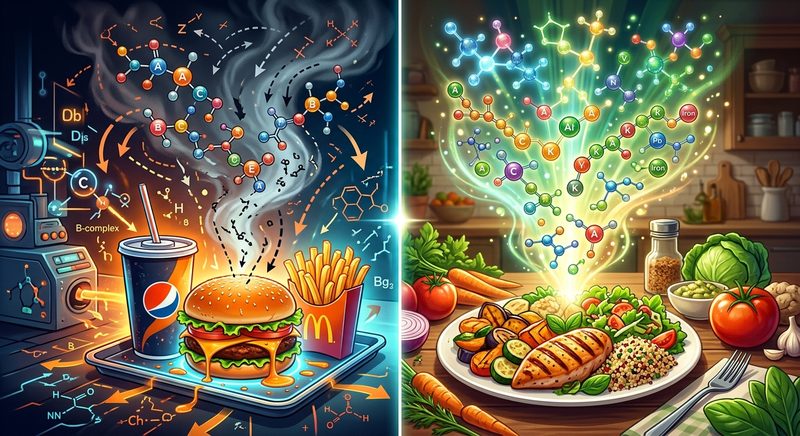
The burger you grabbed at lunch and the one you made at home might share the same basic ingredients on paper. The nutritional story written inside each one is shaped almost entirely by how it was cooked. Temperature, duration, and water contact are the real variables. When industrial production scales those variables up, the chemistry changes in ways most people never see on a label.
What the Science Shows
Industrial cooking methods push nutrient losses well beyond what happens in a typical home kitchen, and the gap is widest for vitamins and antioxidants that heat and water destroy fastest.
- Water-soluble vitamins, including vitamin C and the full B group, are the most affected because they leach into water and degrade under sustained high heat.
- Fast food production involves flash-frying at extreme oil temperatures, pressure cooking, and prolonged holding under heat lamps, which compounds nutrient losses far beyond the initial cook.
- Home cooking is not automatically better, but it gives the cook control over temperature, method, and time in ways that an industrial production line structurally cannot.
What Heat Does to Nutrients at a Molecular Level
Most vitamins are fragile. They are organic compounds held together by chemical bonds that begin to break under heat, pressure, light, and water exposure. The degree of damage depends on three things: temperature, duration of exposure, and whether the food is cooked in water or dry heat.
Fat-soluble vitamins, A, D, E, and K, are comparatively stable. They bind to dietary fat and hold their structure through most cooking conditions. Water-soluble vitamins are a different matter. Vitamin C and the entire B vitamin family dissolve easily into any aqueous environment and degrade rapidly once temperatures rise. When industrial processes push those conditions to their limits, losses compound at every stage of production.
It is worth noting that cooking does not affect all nutrients the same way. Lycopene, the red carotenoid in tomatoes, actually becomes more bioavailable after moderate heat breaks down plant cell walls. The picture is rarely one-dimensional. For the most heat-sensitive nutrients, though, the relationship between temperature and loss is consistent and well-documented across the research literature.
How Industrial Fast Food Cooking Differs From a Home Kitchen
Fast food production operates at a scale that changes the physics of cooking. Proteins are flash-fried at oil temperatures that regularly exceed 175°C (347°F). Burger patties hit contact grills that apply heat from both sides simultaneously, cutting cooking time while generating intense, sustained surface heat. Vegetables in certain products are held under heat lamps for extended periods between cooking and service. Buns pass through steam chambers.
Home cooking rarely reaches those extremes in the same sustained, systematic way. A home cook frying a chicken breast in a pan may use similar peak temperatures, but the process involves a single piece of food, variable contact, and no mandatory holding window. The cook can pull it off the heat and eat it within minutes.
Pressure cooking is another significant factor in commercial kitchens. High-pressure steam cooking, used for certain fast food proteins and side items, raises the boiling point of water and drives cooking temperatures well above 100°C. That speed is efficient. It is also particularly destructive for heat-sensitive vitamins, especially thiamine, which begins to degrade noticeably above 100°C and breaks down rapidly under combined heat and pressure.
Vitamin C Takes the Hardest Hit
Vitamin C, technically ascorbic acid, is among the most heat-sensitive nutrients found in food. The NIH Office of Dietary Supplements has published detailed data on ascorbic acid degradation showing that losses become measurable above 70°C (158°F) and accelerate sharply from there. Water exposure compounds the damage because ascorbic acid migrates directly into cooking liquid, where it is usually discarded.
Industrial frying and flash-cooking expose food to temperatures far above that threshold. Fast food lettuce, raw tomato, and raw onion are typically not cooked at all, which preserves whatever vitamin C they contain at the point of service. But seasoned potato products, battered and fried vegetables, and anything that spends time in hot oil loses a substantial portion of its ascorbic acid content before it ever reaches the tray.
Home cooking gives the cook real options here. Steaming vegetables rather than boiling keeps vitamin C from migrating into water. Shorter cooking times preserve more. Covering the pan traps steam and cuts total heat exposure. None of those choices are available on a commercial line optimized for throughput and consistency.
B Vitamins and the Pressure and Water Problem
The B vitamin group includes thiamine (B1), riboflavin (B2), niacin (B3), pantothenic acid (B5), pyridoxine (B6), folate (B9), and cobalamin (B12). All of them are water-soluble, and several are acutely sensitive to heat. The specific vulnerability varies by compound, but the combination of industrial high heat and pressure creates compounding losses across the group.
Thiamine is particularly fragile. It degrades measurably at temperatures above 100°C and leaches rapidly into water. Industrial pressure cooking accelerates thiamine destruction because it combines both stressors at once. Peer-reviewed research on pork, a common fast food protein, has documented thiamine losses of 50 percent or more under prolonged high-heat processing conditions. That is not an edge case. That is a predictable consequence of the method.
Folate presents a separate problem. It is critical for cell division and particularly relevant during pregnancy. It is also both heat-sensitive and easily oxidized. The industrial holding process, where cooked items sit under heat lamps between preparation and sale, creates ongoing folate degradation that does not stop at the end of the initial cook. The food keeps losing folate as it waits on the line.
Home cooking is not automatically safe from these losses. Boiling vegetables until soft destroys folate just as effectively as any industrial process. The advantage at home is the ability to choose shorter, drier methods like roasting, stir-frying, or quick sautéing that involve less water and less sustained heat exposure.
Antioxidants and High-Heat Breakdown
Beyond classic vitamins, whole foods carry a range of polyphenols, flavonoids, and carotenoids that function as antioxidant compounds. These are the plant pigments and protective molecules that research has linked to reduced oxidative stress. What is consistent across studies is that many of them degrade under sustained high heat, particularly once industrial frying conditions enter the picture.
Polyphenols in onions, bell peppers, and herbs are relatively fragile above certain temperatures. They break down under extended heat exposure and are further degraded by oxidized cooking oil, which is common in high-volume commercial frying operations. Fast food fryers cycle at temperatures that accelerate oil oxidation, and oxidized oil generates compounds that can interfere with antioxidant absorption from the food itself.
This means a fast food meal cooked in oil that has been through multiple high-temperature cycles may deliver fewer antioxidants from its vegetable content and may actively work against the ones that survive the cook. That cumulative disadvantage does not appear anywhere on a nutritional label.
What the Numbers on Nutritional Labels Actually Reflect
Before putting the chemistry above in full context, it helps to know what the baseline figures look like. Reviewing fast food facts for common menu items gives a useful starting point. Those published numbers represent nutrient content at a standardized measurement moment, typically based on freshly prepared samples analyzed under controlled conditions.
What they do not capture is the ongoing degradation that happens between preparation and the moment food is consumed. A french fry analyzed immediately after frying has more vitamin content than one that has sat under a heat lamp for 20 minutes. A burger patty measured at point of service has been through flash-grilling, potential holding, and reassembly. The label captures one snapshot. The actual meal often reflects several more steps of heat exposure and time elapsed.
This is not a reason to dismiss nutritional labels. It is a reason to treat them as approximate best-case figures rather than precise guarantees. They are useful for comparing items and tracking macronutrient targets, but for micronutrient accuracy under real-world conditions, the picture is more complicated than any printed panel can fully convey.
Home Cooking Is Not Automatically a Nutrient Goldmine
The evidence does not support a simple conclusion that every home-cooked meal beats every fast food option on nutrition. Technique matters more than location. A home cook who boils broccoli until it turns gray, stores the leftovers for four days, and reheats them twice has caused real damage to the water-soluble vitamin content of that vegetable. Meanwhile, a fast food item with raw tomatoes and fresh shredded lettuce delivers those ingredients uncooked, preserving whatever heat-sensitive nutrients they carry.
The distinction is control. Home cooking offers the possibility of better nutrient retention because the person at the stove can choose lower temperatures, shorter cook times, less water, and immediate consumption. Fast food production is engineered around consistency, speed, food safety at scale, and shelf stability during holding. Nutrient preservation is not a primary design constraint on a commercial line, and the chemistry reflects that priority gap.
Using methods like roasting instead of boiling, steaming instead of frying, and eating food close to its preparation time are the practices that most reliably protect heat-sensitive nutrients. Those choices are available to a home cook in ways that the industrial food system cannot offer at scale.
Reading the Gap Between the Label and What You Actually Eat
The nutrient gap between fast food and home-cooked meals is real, but it is driven by specific, identifiable mechanisms rather than by some blanket inferiority of one over the other. High temperatures, prolonged heat exposure, pressure cooking, water leaching, and extended holding under heat lamps are the variables that determine how much of a food's vitamin and antioxidant content survives to the point of consumption.
Vitamin C and folate suffer most under industrial conditions because they are water-soluble and heat-sensitive, and those conditions are exactly what industrial methods generate at scale. Thiamine faces the same combination of stressors. Polyphenols and heat-sensitive antioxidants are further eroded by oxidized frying oil and prolonged holding times. These are not theoretical losses. They are predictable consequences of the production method, written into the chemistry of every high-heat, high-pressure commercial cook.
Understanding what heat is doing, and why certain nutrients respond the way they do, is what turns abstract label-reading into something practically useful. At home or anywhere else, cooking that minimizes heat duration, water exposure, and unnecessary holding time delivers more of what was in the food to begin with. That is not a wellness claim. It is just chemistry.